
Protected, without being watched.
Day to day, admins see only usage and cost. Conversations belong to the person and whoever they shared them with.
See for business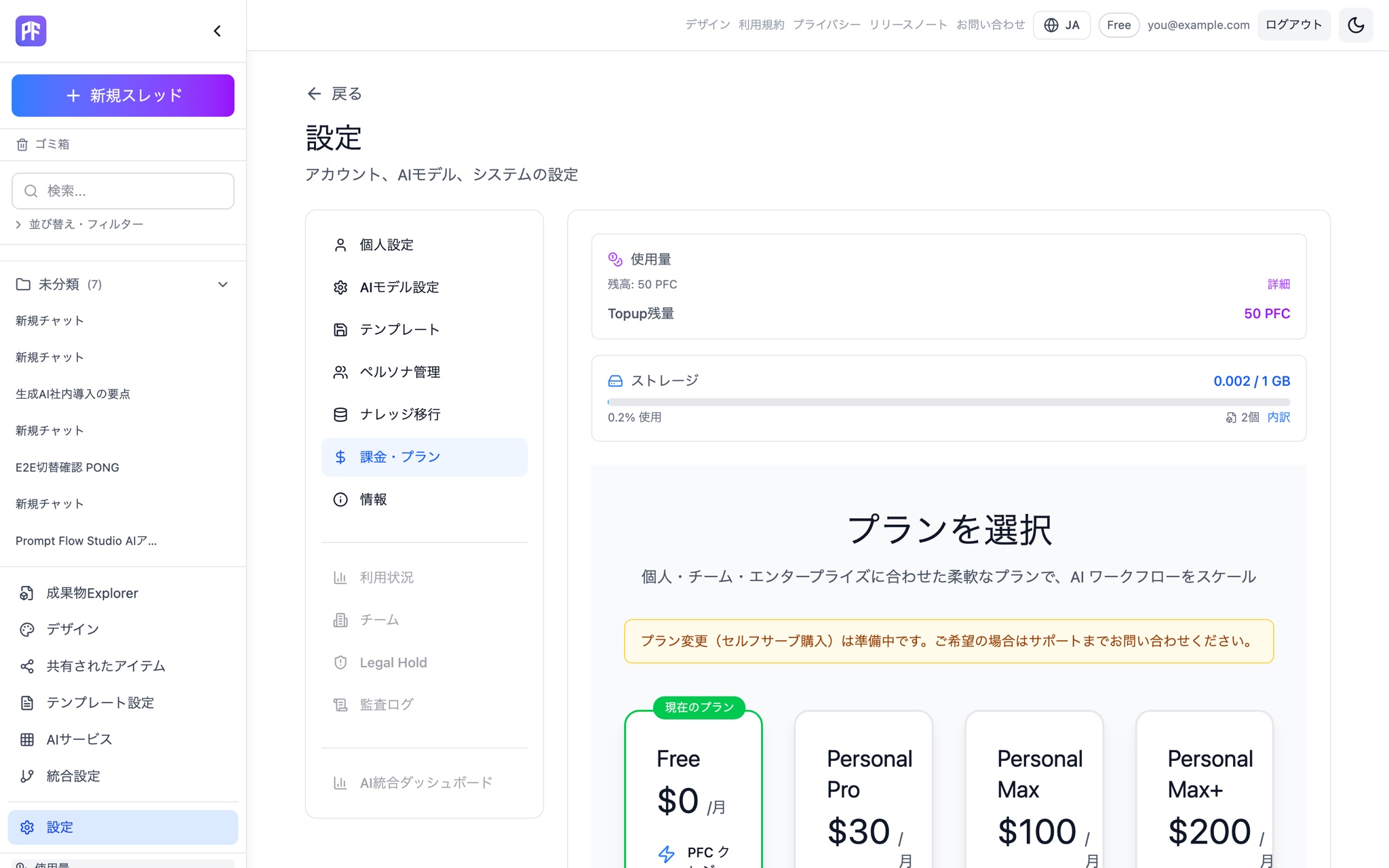
Traceable when it matters.
Audit events are recorded, queryable via API, and exportable. Legal Hold is available to discuss under Enterprise.
See audit logs
Keep company information from leaving.
A Security Filter that detects and masks sensitive data before sending, then restores it in the response, comes standard.
See the feature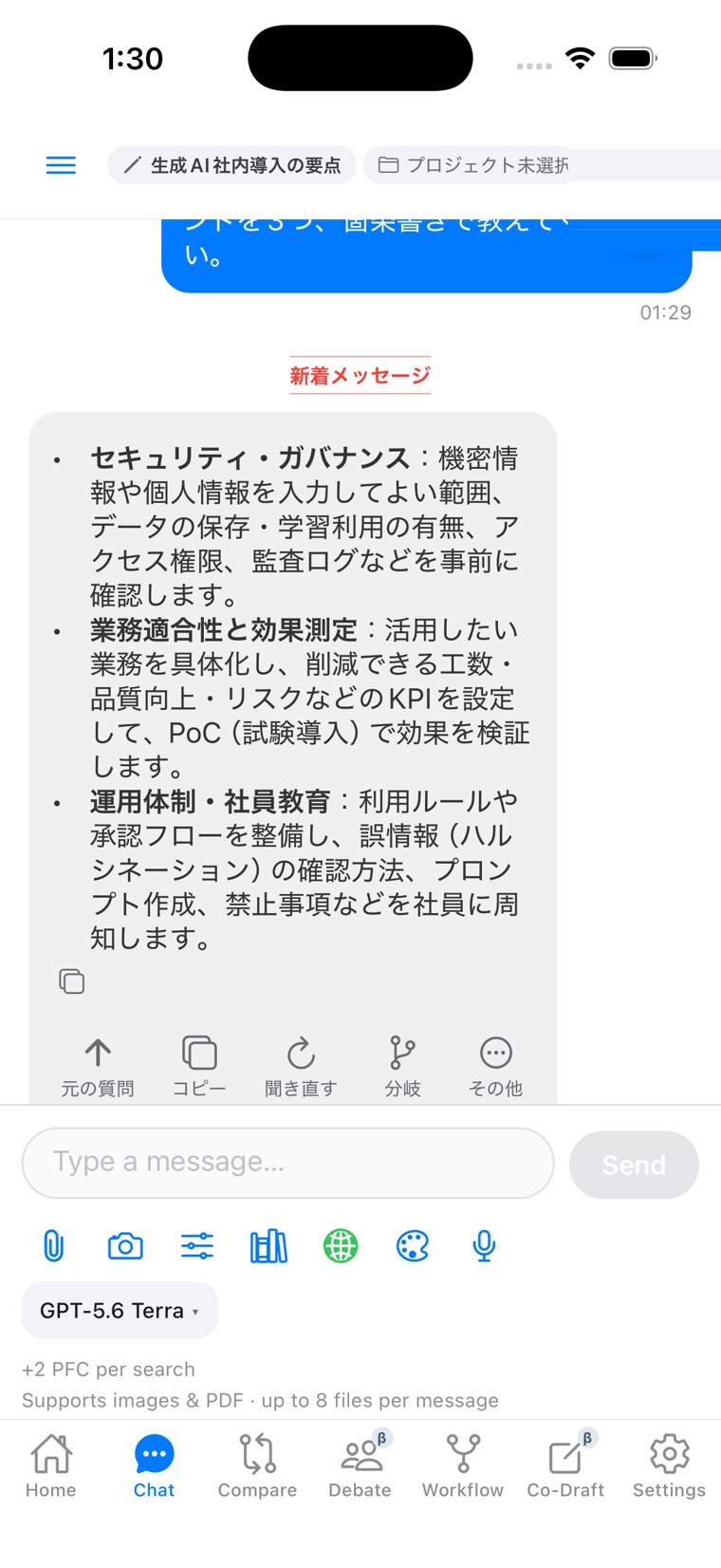
Protect without reading.
Rolling out AI across a team creates two seemingly opposite jobs for admins: respecting each person's privacy, and protecting the company's information. Prompt Flow Studio is built so both can coexist, as a standard part of a multi-AI workspace.
Questions? Contact us.
Who this page is for
IT teams
Checking how authentication and access control work.
Legal & compliance
Checking what's captured in audit logs and how to retrieve it.
Security reviewers
Checking how data is stored and how runaway costs are prevented.
Protect by not looking — not by watching everything.
Day to day, we don't look.
Conversations and generated artifacts belong to the people in them, and whoever they're shared with. What admins see day to day is team usage and cost — PFC consumption and storage usage. Members control who a thread is shared with, through access control lists (ACLs).
When it matters, you can trace it.
Every action is recorded as an audit event: who, when, what. Query it via the audit API any time; CSV/JSONL export with SHA-256 checksums is planned for October 2026 and later. Legal holds for litigation or investigations, and long-term retention, are available to discuss through the Enterprise program.
Company information doesn't leave.
Security Filter detects and masks sensitive or personal information before it's sent, then restores it in the response — standard from the Team plan (Team: detect and warn, Business and above: auto-mask and restore). Contextual detection for Business+ is planned for October 2026 and later. Custom detection rules, bring-your-own detection dictionaries, and an org-wide enforced policy are available to discuss through Enterprise (rolling out from October 2026 onward). Model catalog governance, letting admins control which AI models the organization can use, is also planned.
What admins can see / can't see
This reflects day-to-day operation. Shared threads and legal processes (such as Legal Hold, through the Enterprise program) change what's visible.
| 項目 | Visible | Not visible (day to day) |
|---|---|---|
| Team usage & PFC consumption | ○ | — |
| Contracted seat count | ○ | — |
| Audit event metadata (who, when, what) | ○ | — |
| The content of conversations and artifacts | — | ○ |
Governance only works because it's multi-AI.
When employees sign up for ChatGPT, Claude, and others individually, usage logs and access controls end up scattered across services the company can't see.
Bringing multiple AI providers into a single workspace puts authentication, permissions, and audit logs in one place — which is what makes cross-cutting governance possible in the first place.
What powers this approach
Onion SSO authentication
Login runs through Onion SSO.
Thread-sharing ACLs
Thread sharing is governed by an access control list.
Audit event logging & query API
Actions are recorded as audit events and available through a query API.
Artifacts & knowledge stored in S3
Generated artifacts and uploaded knowledge documents are stored in S3.
Balance guard against runaway cost
Execution stops before your PFC balance runs out, preventing unintended overuse.
What you can discuss through Enterprise
Security Filter comes standard on Team, Business, and Business+ (Team: detect and warn; Business and above: auto-mask and restore; contextual detection and mask-event audit review for Business+ are planned for October 2026 and later). Custom detection rules, bring-your-own detection dictionaries, and an org-wide enforced policy that individual users can't opt out of are available to discuss through the Enterprise program (rolling out from October 2026 onward).
Tamper-evident audit logs (hash chain) come standard on Business and above. Legal holds for litigation or internal investigations, GDPR erasure, and 7-year audit retention (statutory retention, linked to Legal Hold) are available to discuss through the Enterprise program.
Frequently asked questions
Generated artifacts and uploaded knowledge documents are stored in S3.
Related pages
- Audit logs details
- Security Filter
- SSO & SCIM details
- Team & Business plans
- Enterprise (data residency, Legal Hold, and more)
For a direct conversation, use the contact form.
Start with the free plan and try three modes — Chat, Compare, and Debate.
Start free